Showing posts with label bitcoin. Show all posts

Tuesday, November 16, 2021

Is Bitcoin in a Bullish Season ?

Is Bitcoin in a Bullish Season
Is Bitcoin in a Bullish Season ?

According to Citibank’s forecast for the end of 2021, the price of Bitcoin will rise to $ 318 thousand (https://www.nasdaq.com/articles/citibank-analyst-says-bitcoin-could-pass-%24300k-by-december-2021-2020-11-16) . So is this possible?

I think we can answer this with a short analysis.

First of all, we have entered the last turning point of this year. This means that both gains and losses are possible. A smart investor takes a worst-case scenario. In other words, it is useful to take a position as if Bitcoin is going to enter a bearish season.

Investors know well that rising seasons are always followed by bearish seasons.

https://www.investing.com/analysis/bitcoins-price-action-rhymes-with-1970-gold-markets-says-citibank-200544659

The chart is taken from Citibank’s technical analysis for Bitcoin. When we look at the chart, we can see the rising and falling seasons of Bitcoin since 2010. According to the analysis made considering the trends in these seasons, the price that Bitcoin can reach towards the end of this year is above $ 318 thousand.

Bitcoin is called today’s gold. As you know, I have stated in my previous articles, gold and silver are real money. Bitcoin is also seen as a commodity just like gold and silver due to its limited production. This again requires a tight bond with interest, just like in gold and silver. That is, with real interest rates. If we look at it, real interest rates in America, for example, real interest rates on 10-year treasury bills are around minus 1.16 percent. What does this mean? This means increasing demand for commodities like gold, silver and bitcoin.

In the chart, we see the rise of checkable bank depoists after 2020.

What does this mean?

When the wages paid to people even though they are not working are added, it seems that the demand deposits in bank accounts increased from around 800 billion dollars before 2020 to 3 trillion dollars. When the interest rates turn negative in real value, deposits close to 3 trillion dollars await where they will go to invest. Why not bitcoin?

Share:

Thursday, July 29, 2021

Decentralized Finance DEFi


Decentralized Finance  DEFi, The system we are in, which we can also call the money economy, consists of centralized structures to a large extent. We see these central structures as large financial intermediary institutions both in factories with large production capacity in real production and in financial markets. In short, what we call money is a centrally managed exchange tool. This system is about to be left behind now. Thus, in an increasingly digital world, money has also started to be digitalized. Supported by digital infrastructures such as blockchain, crypto coins seem to be candidates for decentralized exchange tools in the system. The best known of these new forms of money is Bitcoin. Bitcoin is a decentralized money that can be transferred from one person to another without the need for intermediary institutions with its decentralization feature. In other words, many financial transactions such as lending, evaluation of savings, insurances, real estate purchases are carried out by intermediary institutions. In this central system managed by a single center or person / s, we witness that incidents such as fraud, mismanagement and corruption occur frequently.

On the other hand, we cannot see such problems in a decentralized system. The transactions listed above can also be performed in a decentralized system. The only difference is that there is no single manager or executive units in this system. In this system, transactions are made transparently in front of everyone and are recorded by everyone. In this way, there is no need for a notary public. Cryptocurrencies traded on decentralized platforms are decentralized. However, the very volatility of these currencies creates doubts about their reliability. Therefore, many cryptocurrencies are valued with the dollar, which is the most valid fiat currency in the system. In this way, they gain stability by being dependent on the dollar. In this case, considering the rapid pace of the system towards crisis, another question is how stable the dollar, which is the reserve currency, can remain. In the central system, the requirements such as opening an account and identity verification for financial transactions supported by infrastructures such as block chain are eliminated. In this way, besides the transparency given by decentralization, unnecessary procedures are eliminated. In decentralized systems, debt demanders and lenders can meet on the same platform without the need for another intermediary. Here, the cryptocurrency owned as collateral for debt is shown and debt dealing can be done in a very practical and autonomous way. Finally, the most important advantages of decentralized systems can be seen as the first steps of the future financial system, as they are open to everyone, flexible, transparent and every transaction is registered and approved by everyone.

Source: https://arzualvan.com/decentralized-finance-defi/


Share:

Tuesday, July 27, 2021

Digital Currencies, Bitcoin and its effect on financial and economic market of USA


An empirical study, Johansen Co-integration test, stationarity, long term relationship

In this article, we will look at the effects of Bitcoin on the American financial market . In fact, digital money can basically be examined in two categories. The first is produced by financial companies and the other is produced by non-financial companies.

As I mentioned in my previous article, credit cards issued by banks can be an example of digital money of financial institutions. The common markets of financial institutions for this type of digital money also serve under the name of internet banking.

As mentioned at the beginning, the effects of bitcoin on the American financial and economic market are studied in this article. In addition, in the analysis, before and after the crisis were examined separately on the basis of the 2008 crisis.

In the study, in which the Bitcoin price was taken as the dependent variable, the variables thought to be explanatory were the ounce gold price, DXY Dollar index, Mortgage index, 10-Year Treasury Rate, Federal Reserve Index USA and 10-Year Bonds.

The model was simply created as follows:

lnBitcoint= b0 + b1 lnGoldt+ b2 lnDollarindext+b3 InMortgageindex+b4 InTreasury rate+b5 10-Year bonds yield+b4 InFederal Reserve Index + et

Differencet-statistics1%5%Probt-statistics1%5%Prob
Level-0.5589-3.67017-2.506230.8665-2.25148-4.3543-3.50140.4459
LBitcoin          1st Difference-6.7288-3.57782-2.92530.0000-6.9899-4.1653-3.50850.0000
Price
Level-2.1368-3.5744-2.92370.0687-3.1161-4.1611-3.50360.0976
LGold Price1st Difference-3.4762-3.5777-2.92510.0096-3.3994-4.1609-3.50810.0432
LDollarLevel-1.6458-3.5847-2.92810.0908-3.8138-4.1756-3.51630.8769
Index1st Difference-7.6874-3.5885-2.92970.0049-5.2701-4.2118-3.52970.0006
LMortgageLevel-1.9598-3.5744-2.92370.3048-1.9310-4.1678-3.50360.6228
Index1st Difference-3.8325-3.5777-2.92510.0196-6.7676-4.1657-3.58850.0347
LTreasuryLevel-2.9134-3.6104-2.93890.0529-2.9991-4.2118-3.52970.1454
Index1st Difference-4.1656-3.6155-2.94110.0038-6.6736-4.2191-3.53300.0190
LFederalLevel7.62134-3.3442-2.56421.00003.8732-4.2923-3.58341.0000
Reserve1st Difference-0.3265-3.6754-2.54670.9094-1.7634-4.6678-3.77810.0129
LBondLevel-2.1277-3.6793-2.76670.2217-2.5832-4.5853-3.57860.2872
Yields1st Difference-4.0543-3.6895-2.76890.0041-3.9938-4.8723-3.98230.0209

The test results are as seen in the table.

Variables were examined on a daily basis.


In the table, it is seen that all of the variables at the level contain unit root. The first differences of the data are stationary with 5% significance level. The Johansen cointegration test is applied to the series which are stationary at the same level as the cointegration test. This study was conducted to find possible cointegration between seven variables, Bitcoin price, Gold price, Dollar index, Mortgage index, Treasury index, Federal reserve index and bond yield, which were found as I(1) and Johansen tests. Thanks to this technique, the dependent variable is Bitcoin price, while the gold price, Dollar index, Mortgage index, Treasury index, Federal reserve index and bond yield are independent variables. According to the results of the test, it was understood that there was cointegration confirming the long-term relationship between the variables.

Finally, we can run a constrained VAR model, which is VECM (vector error correction model), if the variables mean cointegrating, meaning they move together in the long-run association-ship. This model shows the term C (1)>> Error correction…… If C (1) is negative and significant (p value <5%), we can say that there is an Adjustment Speed ​​towards Equilibrium in two issues. There is long-run causality from independent variables to dependent variables.

From Bitcoin price means a long-term relationship with Gold price, Dollar index, Mortgage index, Treasury index, Federal reserve index. Bond yield has a negative relationship with Bitcoin price.

Also read” Digital Currency, Bitcoin (Volume 1)

Share:

Digital Currency, Bitcoin


Is Bitcoin making a significant impact on global financial transactions? (Volume 1)

Digital currencies can be considered as important technological developments that transform the money-based economic system we are in. So what exactly is this thing called digital money? Can Bitcoin-like currencies be considered as a revolt against the central authorities? Or rather, is it a revolt against the management of money and many economic and social activities from central structures, imposed by the money economy-based capitalist system that has been going on for nearly three centuries?

We can say that credit cards and debit cards used in shopping in daily life are digital currencies created by the banking system. On the other hand, non-financial institutions can also produce digital money without the need for regulatory standards. In this way, new types of currencies can be created. Right here, Bitcoin is a sophisticated type of digital currency used for payments and money transfers made by non-financial units online without the need for financial institutions to be a third party or intermediary.

We can say that the concept of digital currency began to be expressed for the first time with DigiCash, which was established in 1990. Money transfer companies such as PayPal followed suit. Thus, it has become an indispensable element of internet shopping more and more on a global scale with the opportunities brought by the developing technology and the widespread use of the internet. In 1998, although the creation of a decentralized digital currency like Bitcoin was started to be considered, the work continued for a while when it did not give the desired results such as reliability and verifiability.

In 2008, the outbreak of a global financial crisis brought the concept of digital currency back to the agenda. The outbreak of the crisis was a kind of opportunity. For the first time, the dream of creating a decentralized financial system with digital currency was becoming a strong possibility.

There are digital currencies with different complex technologies that are starting to appear in the financial markets today. Digital money was defined by the IMF in 2008 in two main categories. One of them is hardware-based digital currency while the other is software-based digital currency. An example of a hardware-based digital currency is credit cards issued by banks. Software-based cryptocurrencies, on the other hand, are those used for remote transactions.

Blockchain-based Bitcoin software, developed by a software developer, whose pseudonym is said to be Satoshi Nakamoto, together with a group of software developers, came to the fore in January 2009.

Blockchain technology, in short, is a peer-to-peer network type and a technology that terminates duplicate transactions with transaction records of all users made with cryptography. The system is decentralized, making hacking difficult but not impossible.

What makes Bitcoin privileged is that it is a decentralized currency that cannot be controlled by any group. Despite what it may seem like, we’ve only recently seen a market fluctuating with a tweet from investors like Elon Mask, who owns large amounts of Bitcoin.

In February 2017, there were about 720 cryptocurrencies. Bitcoin made up about 80 percent of the cryptocurrency market. As of February 2017, the total market capitalization of all cryptocurrencies was around $19 billion, with the top 15 currencies accounting for more than 97% of the market, with 7 of them contributing 90% of the entire market cap.

When we look at the academic literature, we see that there are a significant number of studies on Bitcoin. These studies gained momentum as of 2012. Most of these studies are done in engineering fields. The most emphasized subjects in the studies are on the technical infrastructures of cryptocurrencies. Some of these studies are briefly as follows: Ryan Farell examined the cryptocurrency market using the “consensus mechanism” in his study published in 2015 (Ryan Farell (2015). An analysis of the cryptocurrency industry. Wharton Research Scholars; http://repository.upenn.edu/wharton_research_scholars/130). In the study, it was emphasized that the Bitcoin industry is quite reliable against major thefts.

The first payment transaction using Bitcoin was among the users of the “Bitcointalk forum” in 2010. In this transaction, two pizzas were purchased with 10000 Bitcoin. As of January 1, 2011, one Bitcoin was worth $0.30, with the total market cap exceeding $1 million. Bitcoin peaked at around $20,000 in December 2017 and accompanied the rise in popularity of the cryptocurrency. December 2018, 2019, 2020 reached $3743.91, $7301.07, $27036.69 respectively.

Finally, as of July 2021, it is at the level of 33 thousand dollars. The total value of the market is at the level of 1 trillion dollars as of the same month. Although it is still far below the total value of the global financial market, its progress is remarkable.

In my ongoing articles, I will share the academic study results of Bitcoin’s contribution to the financial market, please stay tuned.

Source: https://arzualvan.com/digital-currency-bitcoin/

Share:

Cryptocurrencies Energy Consumption

 Cryptocurrencies continue their adventures that started with Bitcoin in 2009 by accelerating. The cryptocurrency market has grown significantly. Blockchain technology, which came to the fore with Bitcoin, seems to have an important role in the transformation of the financial and economic system.

The system we are in ignores the feature of being the basis of the future financial system, seeing the blockchain technology that will transform itself and crypto money such as bitcoin as an environment where money laundering is more common. Although cryptocurrencies have become widespread in recent years, there are also common opinions that most of them will not be in the future.

On the other hand, the energy used in bitcoin mining has attracted the attention of environmentalists, and concerns that global warming will increase if it becomes widespread.

Bitcoin and Ethereum, pioneers of cryptocurrencies, are produced through a process called mining, which uses the computer process to solve sophisticated algorithms. Huge data centers are being set up that consume huge amounts of energy to mine Bitcoin. Miners moved to China and South Korea because electricity is cheaper than in the Midwest.


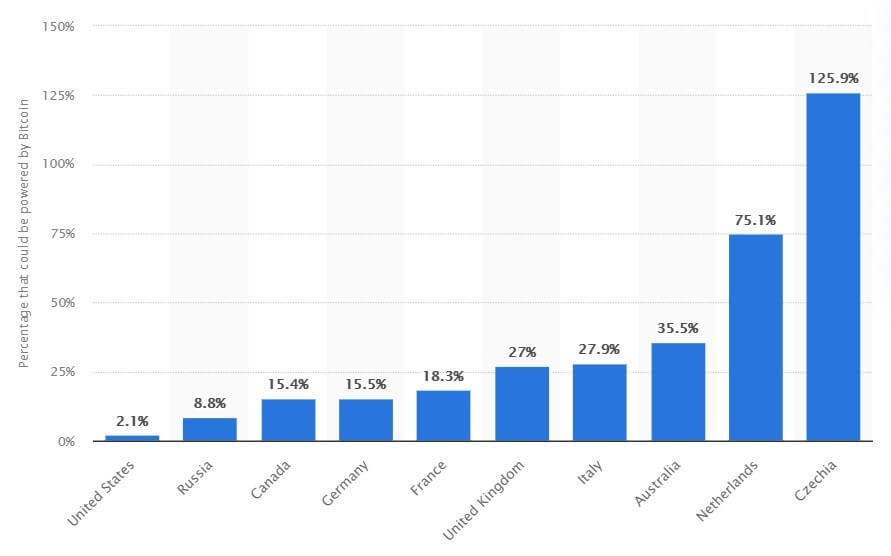
Source: https://www.statista.com/statistics/881522/bitcoin-energy-consumption-relative-to-select-countries/

In the chart, the ratios of the energy consumed in Bitcoin mining to the country’s energy consumption are given. Accordingly, the energy used in Bitcoin mining is approximately 1.25 times the total energy consumption of Czechia. When this rate is compared with the Netherlands, it is seen that it is about seventy-five percent of the total energy used by the country.

As can be seen from this, environmentalists are not wrong in their reactions. It is clear that the Proof of Work technology used in Bitcoin mining is increasingly causing high energy consumption.

Proof of Work is a system that validates functions and limits abuse by using computational resources to calculate algorithms. Mining uses more energy each year than several countries combined. This increase in energy consumption in the economy could open up a new market for utilities.

In fact, the population buys the application-specific integrated circuit (ASIC), an integrated circuit designed for specific mining use. Cryptocurrency mining data centers generate a lot of heat. Mining not only needs computational power to solve complex algorithms, but data centers also need energy to keep their servers comfortable.

In 2017, the Venezuelan authority closed the execution of the mining process due to the illegal operation of 11000 computers. The country suffered serious consequences as a result of the consumption of electricity, including blackouts. Companies around the world are investing in more sustainable technologies to reduce the harmful effects of bitcoin mining on the environment.

Proof of Work versus Proof of State.

The main difference is that proof of work requires a very powerful external source (“mining hardware”) because proof of work is not. Proof-of-work critics argue that fewer people will be motivated to mine as Bitcoin prices/rewards/fees fall. As a result, the protection of the system is reduced. Since staking/adding new blocks to the blockchain is free, critics of staking argue that you can use it to stake multiple identical coins at the same time.

As a result, Bitcoin is produced with blockchain technology, which will form the financial and economic infrastructure of the future, and for now, the energy needed by this technology is too big for the world to handle.

However, this does not mean that the technology will be abandoned. It only reveals the necessity of searching or producing new energy sources. Perhaps in the future, new technologies will be developed that are similar to blockchain but require much less energy.

Source: https://arzualvan.com/cryptocurrencies-energy-consumption/

Share: